
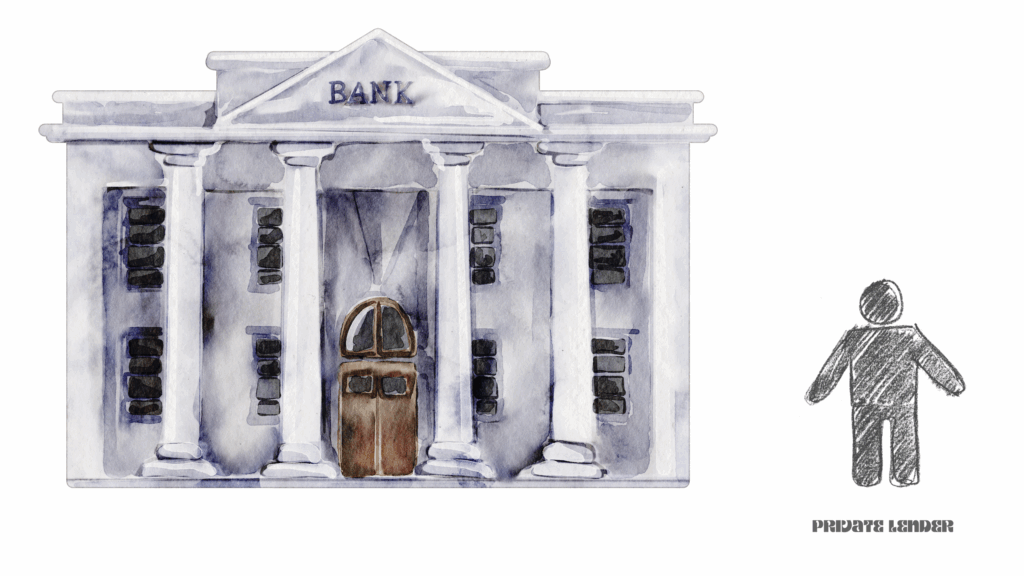
Understanding the fundamental differences between private and institutional mortgage lending models is crucial for anyone involved in the Canadian mortgage market. These models differ in their purpose, structure, speed, regulation and approach to risk.
It is important to note that banks and credit unions sell a suite of products to mortgage customers, like insurance, investments, brokering, wealth management services, credit cards, unsecured lines of credit and savings accounts. This translates to numerous revenue streams. Private lenders typically have one product: short-term mortgage capital.
Underwriting and Borrower Profile
Private Lenders
Private lenders use an asset-based underwriting approach. Their primary focus is on the value, location and marketability of the real estate securing the loan.
The key questions they ask are:
- What is the Loan-to-Value (LTV) ratio?
- Is the property a good, marketable asset?
- Does the borrower have a clear and realistic exit strategy?
This flexible, case-by-case analysis allows private lenders to serve borrowers who do not fit conventional criteria. For example, a borrower with a recent bankruptcy or poor credit history may still qualify for a loan if they have significant equity in their property.
Common Borrower Profiles Include:
- Self-employed individuals with income that is challenging to verify with traditional documentation.
- Borrowers in foreclosure or arrears, who need urgent financing to protect their property.
- Real estate investors requiring bridge financing for a new purchase or renovations.
- Property owners seeking to extract equity from unconventional assets, such as mixed-use, rural or vacant land.
Institutional Lenders (e.g. Banks, Trust Companies, Credit Unions)
Institutional lenders employ a policy-driven underwriting model. Decisions are based on strict, federally regulated guidelines and internal risk policies. They rely heavily on automated underwriting systems that analyze a borrower’s financial history and creditworthiness. Their focus is on the borrower’s GDS/TDS ratios, credit score, employment stability and demonstrated ability to service long-term debt.
These lenders are inherently risk-averse and seek borrowers who demonstrate long-term stability and a proven track record of financial responsibility. Borrowers with recent credit issues, non-traditional income sources or unconventional assets are often declined, regardless of the equity they hold in a property.
Loan Structure and Terms
Private Lenders
- Short-Term Focus: Most private mortgages are structured as interest-only loans with terms typically ranging from 6 to 18 months.
- Upfront Fees: Profitability is driven by upfront fees. Lender fees and broker fees (often totaling 3% to 6% of the loan amount) are typically deducted directly from the loan proceeds at closing.
- Balloon Payment: The entire principal balance, plus any accrued interest, is due as a single balloon payment at the end of the term.
- Interest Rates: Rates are significantly higher than institutional rates, generally ranging from 8% to 14% or more, reflecting the higher risk and the short-term nature of the loan.
Institutional Lenders
- Long-Term Amortization: These loans are structured for the long term, with amortizations of 25 to 30 years and terms of 1 to 10 years.
- Principal and Interest Payments: Each monthly payment includes both principal and interest, gradually paying down the loan over time.
- No Lender Fees: Banks generally do not charge significant origination or lender fees. Their profit comes from the long-term collection of interest.
- Lower Rates: Rates are much lower, with residential mortgages for well-qualified borrowers often ranging from 2% to 5% depending on market conditions.
Speed and Process
Private Lenders
- Rapid Turnaround: Private lenders can issue a loan commitment in as little as 24 to 72 hours, with funding often occurring within 5 to 10 business days.
- Streamlined Due Diligence: The process is simplified and focuses on the property’s appraised value, title search, and the borrower’s proposed exit strategy.
- Direct Decision-Making: Many private lenders are owner-operated, allowing for quick, direct decisions without multiple layers of review.
Institutional Lenders
- Slower Process: The approval process can take 10 to 30 business days or longer due to multiple layers of review, including underwriting, credit adjudication, and risk committees.
- Extensive Documentation: A lengthy process of verifying income, employment, and credit history is required.
Risk Mitigation: The extensive verification process is a form of risk mitigation, designed to protect the institution’s capital by ensuring the borrower meets all internal and external standards.